What’s the Process Behind Titanium Rivets Manufacturing?
The manufacturing process of titanium rivets begins with the extraction of high-purity titanium raw materials. Usually, ilmenite is converted into sponge titanium by the Krowl method, with a purity of 99.7%. Subsequently, it is cast into titanium ingots weighing up to 6 tons at a high temperature of 1700°C through vacuum consumable arc melting technology. Energy consumption at this stage accounts for 40% of the total production cost, but electricity expenses can be reduced by 15% through power optimization of electric arc furnaces. Taking the smelting automation system implemented by Baoti Group in 2023 as an example, it has raised the qualification rate of titanium ingots from 92% to 98%, increased annual output by 3,000 tons, and directly reduced raw material waste losses by approximately 50 million yuan.
During the hot forming stage, titanium ingots need to undergo multiple rolling and forging processes. The initial heating temperature must be precisely controlled within the range of 950°C to 980° C. By applying pressure through an 8,000-ton hydraulic press, the titanium billets are rolled into bars with diameters ranging from 5 to 50 millimeters, and the dimensional tolerance must be maintained within ±0.1 millimeters. Boeing's supply chain data shows that the isothermal forging technology can refine the internal grain size of titanium rivets to 10 microns, increase the tensile strength to 1100 megapascals, and improve the fatigue life by 50% compared with traditional processes. The mold loss rate in this stage is approximately 3%, but the mold service life can be extended to 10,000 cycles through surface nitriding treatment.
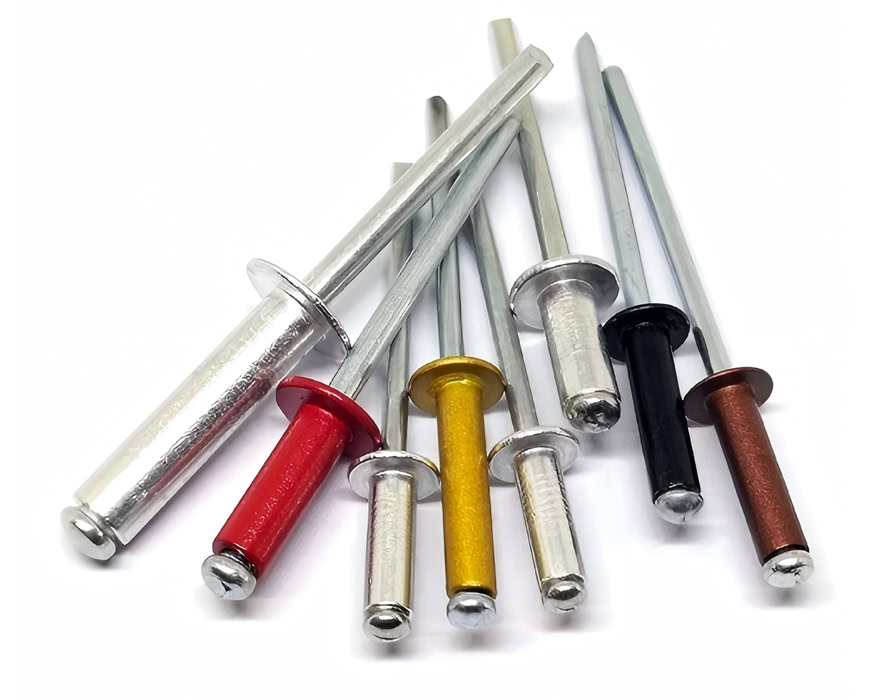 Mechanical processing is the core link in the manufacturing of titanium rivets. Multi-station CNC machines perform cold heading on titanium rods at a speed of 8,000 revolutions per minute, capable of producing 120 rivets per minute, with diameters ranging from 1.6 millimeters to 19 millimeters. During the processing, cutting fluid should be continuously injected to maintain the temperature below 80°C and prevent the material from hardening. According to the practice of the American aerospace manufacturer Spirit AeroSystems, after introducing the five-axis linkage machining center, the roundness error of titanium rivets was reduced from 0.05 millimeters to 0.01 millimeters, the assembly efficiency was increased by 20%, and the processing cost per piece was reduced by 1.2 US dollars.
In the surface treatment stage, electrolytic polishing technology was adopted. The surface was treated in a bath solution with a 15% concentration of hydrofluoric acid for 3 minutes, reducing the surface roughness Ra value from 1.6 microns to 0.4 microns. The strict quality control system requires that 300 samples be taken from each batch for salt spray testing to ensure that the corrosion area is less than 0.01% after 500 hours of 5% sodium chloride spray. For instance, the titanium rivets used in the Airbus A350 model, after undergoing anodizing treatment, have an oxide film thickness of 8 microns, which extends the product's service life in coastal environments from 15 years to 30 years and reduces the maintenance frequency by 60%.
In the final quality inspection stage, an industrial CT scanner is used to detect the internal defects of the rivets, with a resolution of 2 microns, capable of identifying pores larger than 3 microns in diameter. Statistics show that the full-process quality control has enabled the factory qualification rate of titanium rivets to reach 99.95%, an increase of 0.3 percentage points compared to ten years ago. According to the requirements of the international aerospace quality standard AS9100 certification, 15% of the spare samples of each batch of products need to be retained for life cycle assessment. This rigorous Titanium rivets manufacturing process ensures that in the application of the C919 passenger aircraft, the failure probability of the rivet connection structure is less than 0.5 per million.
Mechanical processing is the core link in the manufacturing of titanium rivets. Multi-station CNC machines perform cold heading on titanium rods at a speed of 8,000 revolutions per minute, capable of producing 120 rivets per minute, with diameters ranging from 1.6 millimeters to 19 millimeters. During the processing, cutting fluid should be continuously injected to maintain the temperature below 80°C and prevent the material from hardening. According to the practice of the American aerospace manufacturer Spirit AeroSystems, after introducing the five-axis linkage machining center, the roundness error of titanium rivets was reduced from 0.05 millimeters to 0.01 millimeters, the assembly efficiency was increased by 20%, and the processing cost per piece was reduced by 1.2 US dollars.
In the surface treatment stage, electrolytic polishing technology was adopted. The surface was treated in a bath solution with a 15% concentration of hydrofluoric acid for 3 minutes, reducing the surface roughness Ra value from 1.6 microns to 0.4 microns. The strict quality control system requires that 300 samples be taken from each batch for salt spray testing to ensure that the corrosion area is less than 0.01% after 500 hours of 5% sodium chloride spray. For instance, the titanium rivets used in the Airbus A350 model, after undergoing anodizing treatment, have an oxide film thickness of 8 microns, which extends the product's service life in coastal environments from 15 years to 30 years and reduces the maintenance frequency by 60%.
In the final quality inspection stage, an industrial CT scanner is used to detect the internal defects of the rivets, with a resolution of 2 microns, capable of identifying pores larger than 3 microns in diameter. Statistics show that the full-process quality control has enabled the factory qualification rate of titanium rivets to reach 99.95%, an increase of 0.3 percentage points compared to ten years ago. According to the requirements of the international aerospace quality standard AS9100 certification, 15% of the spare samples of each batch of products need to be retained for life cycle assessment. This rigorous Titanium rivets manufacturing process ensures that in the application of the C919 passenger aircraft, the failure probability of the rivet connection structure is less than 0.5 per million.
Mechanical processing is the core link in the manufacturing of titanium rivets. Multi-station CNC machines perform cold heading on titanium rods at a speed of 8,000 revolutions per minute, capable of producing 120 rivets per minute, with diameters ranging from 1.6 millimeters to 19 millimeters. During the processing, cutting fluid should be continuously injected to maintain the temperature below 80°C and prevent the material from hardening. According to the practice of the American aerospace manufacturer Spirit AeroSystems, after introducing the five-axis linkage machining center, the roundness error of titanium rivets was reduced from 0.05 millimeters to 0.01 millimeters, the assembly efficiency was increased by 20%, and the processing cost per piece was reduced by 1.2 US dollars.
In the surface treatment stage, electrolytic polishing technology was adopted. The surface was treated in a bath solution with a 15% concentration of hydrofluoric acid for 3 minutes, reducing the surface roughness Ra value from 1.6 microns to 0.4 microns. The strict quality control system requires that 300 samples be taken from each batch for salt spray testing to ensure that the corrosion area is less than 0.01% after 500 hours of 5% sodium chloride spray. For instance, the titanium rivets used in the Airbus A350 model, after undergoing anodizing treatment, have an oxide film thickness of 8 microns, which extends the product's service life in coastal environments from 15 years to 30 years and reduces the maintenance frequency by 60%.
In the final quality inspection stage, an industrial CT scanner is used to detect the internal defects of the rivets, with a resolution of 2 microns, capable of identifying pores larger than 3 microns in diameter. Statistics show that the full-process quality control has enabled the factory qualification rate of titanium rivets to reach 99.95%, an increase of 0.3 percentage points compared to ten years ago. According to the requirements of the international aerospace quality standard AS9100 certification, 15% of the spare samples of each batch of products need to be retained for life cycle assessment. This rigorous Titanium rivets manufacturing process ensures that in the application of the C919 passenger aircraft, the failure probability of the rivet connection structure is less than 0.5 per million.