What Premium Fragrance Manufacturing Changes on the Production Line
Premium fragrance manufacturing is easier to recognise in a finished bottle than in a quotation. On the line it usually means a narrower palette of more expensive materials, tighter control of blending and filling, and documentation that travels with the batch. None of those choices is free, and none of them is automatically right for a given project, which is why the useful question is not whether a supplier is premium but where the extra spending lands.
Key takeaways
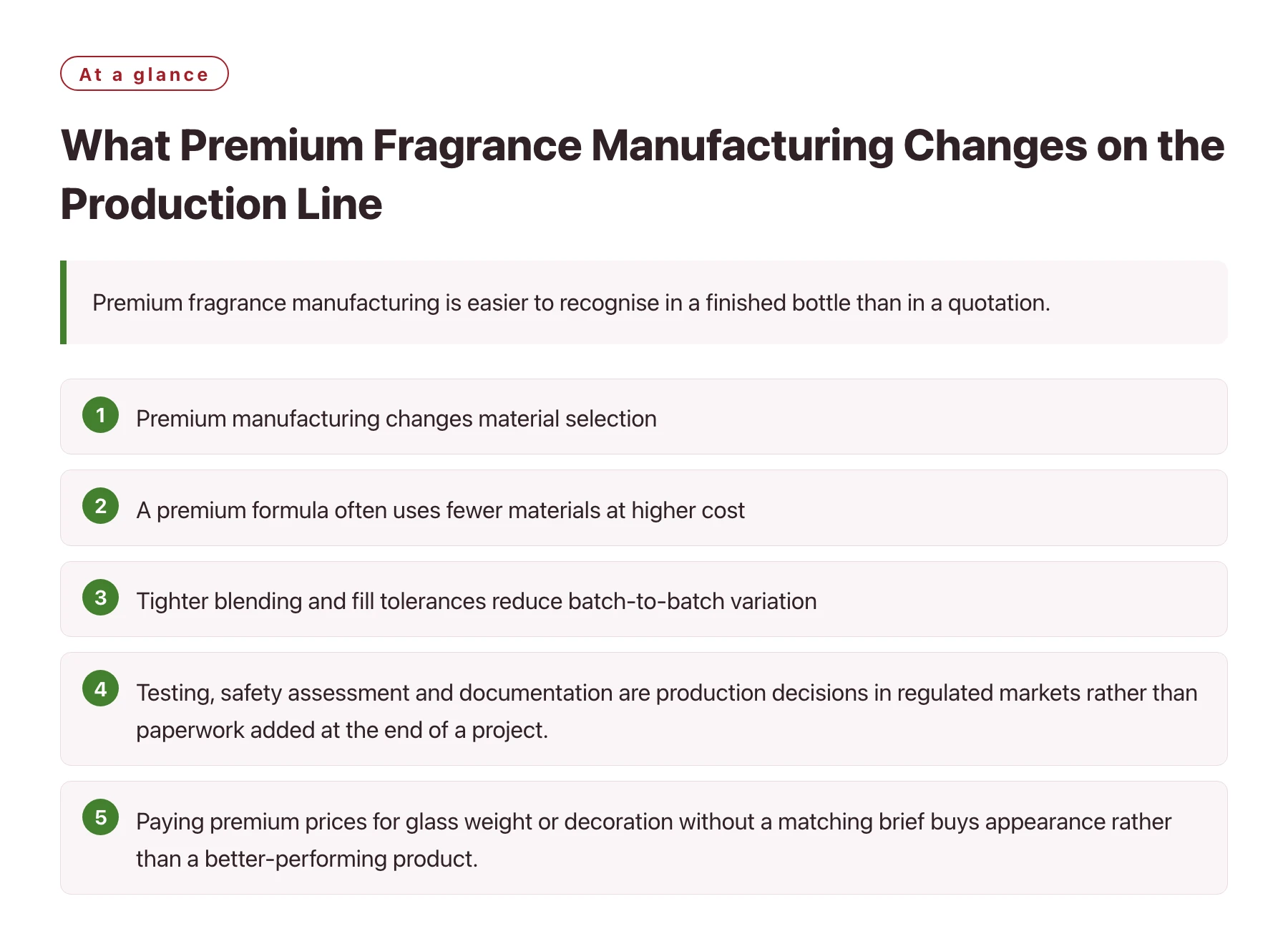
- Premium manufacturing changes material selection, process control and documentation scope, not merely the fragrance load in the bottle.
- A premium formula often uses fewer materials at higher cost, so character comes from distinctive ingredients rather than from complexity.
- Tighter blending and fill tolerances reduce batch-to-batch variation, and that consistency is what customers notice between reorders.
- Testing, safety assessment and documentation are production decisions in regulated markets rather than paperwork added at the end of a project.
- Paying premium prices for glass weight or decoration without a matching brief buys appearance rather than a better-performing product.
Ask five suppliers what makes their production premium and you will hear five different answers. One will point at materials, another at machinery, a third at certification, a fourth at hand finishing and a fifth at the bottle itself. All five are describing something real, and none of them is describing the whole picture.
For a brand deciding where to spend, the more useful exercise is to separate the parts of a project that genuinely improve the product from the parts that only change how it photographs. That distinction drives the table below and the qualification steps that follow it.
Where a premium brief spends differently
| Project element | Cost-first approach | Premium-first approach | What changes downstream |
|---|---|---|---|
| Fragrance compound | Fewer costly materials, wider use of common aroma chemicals | Smaller, more distinctive material palette used at higher cost | Character and longevity, plus the reformulation headroom you keep |
| Container and closure | Stock bottle, standard closure, simple decoration | Custom mould, heavier glass, multi-pass decoration | Tooling investment, lead time and reorder cost |
| Blending and filling | Standard procedures with routine checks | Tighter fill control and extra in-process inspection | Batch-to-batch consistency between first order and reorder |
| Testing and documentation | What the destination market requires as a minimum | Broader testing scope and a fuller technical file | Easier market entry and a shorter conversation at customs or audit |
| Resting before release | Released as soon as the batch passes checks | Held longer so the scent settles before shipping | How the product smells on the day the customer opens it |
The final column is the one to argue about internally. If a premium line item does not change something in that column, it is decoration rather than manufacturing, which is a legitimate choice as long as everyone knows that is what it is.
What premium actually buys on the line
Three changes show up repeatedly when a project moves from a cost-driven brief to a premium one: how materials are chosen, how tightly the process is held, and how much of the technical story is documented.
Material selection narrows rather than widens
A cost-driven formula often reaches an effect by combining many inexpensive materials. A premium formula tends to do the opposite: a smaller number of distinctive, more expensive materials, each doing more work. That makes the scent harder to copy and easier to describe.
The major fragrance houses publish extensively on ingredient development and on how they segment their portfolios, which is a useful reminder that the character of a premium formula usually comes from a handful of choices rather than from sheer ingredient count [1].
Tolerances tighten, and that is the visible part
Fill weight drift and small blending differences are invisible on a single bottle and obvious across a pallet. Premium production tightens the tolerance band and inspects more often inside it, which costs time on the line and shows up as consistency in the market.
This is also the least glamorous part of a premium claim, and therefore the easiest to verify. Ask how fill weight is checked and how often, and how a batch that sits outside the band is handled.
Documentation becomes part of the product
In regulated markets, the technical file is not an appendix. Independent laboratories such as SGS test cosmetics and personal care products against GMP and conformity requirements, and the scope of that testing is decided during development rather than after production [2].
Safety assessment sits in the same category. Scientific advice from the EU Scientific Committee on Consumer Safety informs how fragrance materials and allergens are evaluated [3], and that framework shapes which claims and formulations are realistic for a European launch.
Qualifying a premium production partner
- Ask for the material logicHave the perfumer explain why specific materials are in the formula and what each contributes; a premium story should survive that question.
- Compare tolerance bands, not adjectivesAsk how fill weight and blending are controlled and what happens when a batch drifts outside the band.
- Walk one batch record end to endAsk the premium fragrance production partner to take you through a single batch record from raw material intake to release; the level of detail tells you more than a showroom.
- State the target markets earlyTesting scope and documentation depth follow the markets you intend to sell in, so naming them before sampling prevents rework later.
- Confirm what a reorder will look likePremium consistency is only valuable if the second order matches the first, so ask what is retained and compared at reorder.
The most expensive mistake in a premium project is buying premium inputs without a premium brief. A heavier bottle, a custom mould and multi-pass decoration will not rescue a formula that was specified only as a direction and a price. Before the budget is committed, write the four things that premium spending is supposed to protect: the wear experience at hour four, the consistency between orders, the markets the product can legally enter, and the cost ceiling that keeps the line viable. If a proposed upgrade does not protect one of those four, it belongs in a different conversation.
Where premium money is wasted
Premium is not a setting that can be switched on across a project. It is a set of specific choices, and the same amount of money can be spent well or badly depending on where it goes.
Upgrades nobody can perceive
A heavier closure and a more elaborate carton are noticed once, in the hand, and never again. That can be worth paying for, but the decision should be made by whoever owns the brand experience rather than inherited by default from a competitor's specification sheet.
Expertise is the part that compounds
The durable premium asset is a team that can explain its own decisions. Industry bodies such as The Fragrance Foundation exist to support perfumery education and professional standards [4], and that educational layer is one reason a well-run premium project can be described in sensory language rather than in adjectives.
Manufacturers in Guangzhou, including Xuelei, which describes 31 years of fragrance and home fragrance production and holds ISO 22716, GMPC, ISO 9001, ISO 14001 and ISO 45001, present these systems as the baseline for a project rather than as the product itself. That is the right frame: the certificate describes the system, and the brief decides what the system is used for.
Sources
- Givaudan —— One of the largest fragrance and flavour houses; public material on fragrance creation, ingredient portfolio and market segments.
- SGS: Cosmetics, Personal Care & Household Testing —— Testing, inspection and certification services for cosmetics and personal care, including microbiological, stability and safety testing aligned with cosmetics GMP.
- EU Scientific Committee on Consumer Safety (SCCS) —— The EU scientific committee that issues opinions on the safety of cosmetic ingredients, including fragrance allergens and their labelling thresholds.
- The Fragrance Foundation —— A non-profit organisation for the fragrance industry, running perfumery education programmes and industry recognition.
Frequently asked questions
Is premium fragrance manufacturing worth the extra cost?
It depends on which part of the project is premium. Spending on material quality, process tolerance and documentation tends to show up in the product and in market access. Spending on glass weight and decoration changes presentation rather than performance. Decide which of the two your brand needs before the budget is fixed.
Does a higher fragrance load make a product premium?
No. Load is a ratio, not a quality marker. A premium impression comes from which materials are in the formula and how they are balanced. A modest load built on distinctive materials can read as richer and more distinctive than a heavier load built on common aroma chemicals.
What documentation should accompany a premium fragrance order?
At minimum, the specification the batch was produced against, a certificate of analysis, and the safety and labelling documentation the destination market requires. The exact list depends on where you sell, so it is worth confirming the scope in writing before the first order is placed.
How can I tell whether a factory is genuinely premium or only priced that way?
Ask process questions rather than presentation questions. How fill weight is controlled, how a batch outside tolerance is handled, what happens at reorder, and how the technical file is assembled. Suppliers who answer specifically are usually describing a real system rather than a marketing position.
Can a smaller brand buy premium production without a large order?
Often yes, but the premium usually shifts from tooling to materials. A custom mould needs volume to make sense, while a better fragrance compound and a tighter filling specification can be applied to a modest first order. Ask which premium choices scale down and which only make sense at volume.