How Are custom hydraulic hoses Used in Mining and Agricultural Equipment?
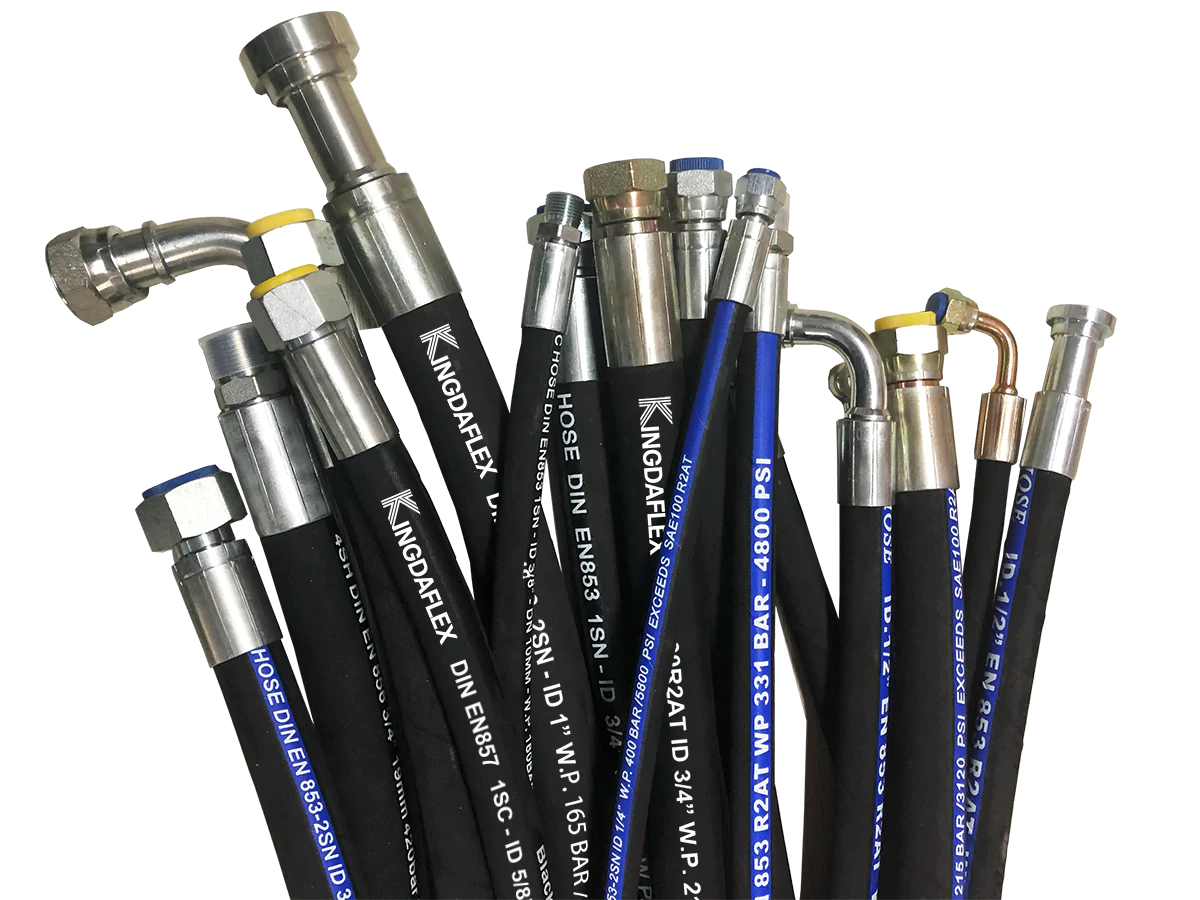
Custom hydraulic hoses carry pressurized fluid between pumps, valves, cylinders, motors, and moving attachments where rigid tubing cannot follow machine movement. Mining excavators, loaders, drills, tractors, combines, sprayers, and balers may work with hydraulic circuits above 3,000 psi, while some heavy-duty hose classes reach 5,000 psi. Hose selection is based on pressure, inside diameter, bend radius, temperature, fluid, fitting type, and movement rather than machine size alone. ISO 18752:2025 covers 10 pressure classes, four performance grades, seven hose types, and nominal sizes from 5 to 102 mm, showing how widely operating requirements can differ across mobile hydraulic equipment.
A mining excavator provides a clear example. Its boom, stick, bucket, swing, travel, and auxiliary attachment circuits all depend on hydraulic power, but the hoses do not experience identical conditions. A boom hose repeatedly changes position as cylinders extend and retract, while a hose inside the machine body may remain almost stationary. Length therefore has to include full joint travel rather than simply matching the shortest distance between two ports.
That movement makes routing as important as pressure rating. A hose that is 5% too short can be pulled tightly near a fitting at full cylinder extension, while excessive length can create loops that rub against guards, steel frames, or neighboring hoses. Manufacturers normally specify a minimum bend radius for every hose family, and routing below that value places greater stress on reinforcement and the area directly behind the fitting.
Hose length should be checked with the boom, steering joint, loader arm, or implement moved through its usable range. A hose that fits while the machine is parked can still become stretched, twisted, or pinched at maximum articulation.
Mining machines add abrasion and impact exposure to the routing problem. Rock fragments, dust, mud, frame edges, and continuous vibration can wear through an outer cover long before internal pressure damages the reinforcement. Underground equipment can also face flame-resistance requirements; U.S. MSHA testing under 30 CFR 18.65 uses four hose specimens, each 6 inches long and 1/2 inch wide, when evaluating flame behavior.
For exposed positions, a custom assembly may therefore combine a high-pressure wire-reinforced hose with abrasion-resistant covering, spiral guard, textile sleeve, or spring protection. Protection is most useful after routing has removed avoidable contact points. A sleeve does not compensate for a hose permanently rubbing against a sharp bracket during thousands of boom cycles.
Pressure selection introduces another engineering limit. SAE J517 covers common hydraulic hoses used on mobile and stationary machinery and states that an assembly must not exceed the lower maximum working pressure of its hose or connector components. A 5,000 psi hose attached to a fitting approved for 4,000 psi remains a 4,000 psi assembly, not a 5,000 psi one.
| Application | Typical hose concern | Custom specification commonly adjusted |
|---|---|---|
| Mining excavator boom | Flexing and abrasion | Length, bend radius, protective cover |
| Hydraulic breaker | Pressure pulses and movement | Reinforcement, fittings, sleeve |
| Wheel-loader articulation | Repeated steering movement | Length, fitting angle, routing |
| Tractor loader | Continuous arm movement | Hose length, couplings, abrasion cover |
| Folding sprayer boom | Large travel range | Flexibility, clamps, fitting orientation |
| Baler or seeder | Tractor-to-implement movement | Length, quick couplings, routing |
The pressure difference also explains why copying a hose only by outside diameter is unreliable. U.S. defense technical data citing SAE J517 replacements shows examples ranging from 3,000 psi for a -20 size 100R12 assembly to 5,000 psi for a -12 size 100R13 assembly. Hose construction and size both influence permitted operating pressure, so visual similarity does not establish interchangeability.
Agricultural machinery applies the same principles under a different duty pattern. A tractor front loader may raise, lower, curl, and dump hundreds of times during a working day, while a baler gate or folding cultivator may operate less frequently but require a much longer range of hose movement. Dust, crop residue, fertilizer, moisture, sunlight, and seasonal storage add environmental exposure that must be considered with pressure.
A tractor-to-implement connection adds another variable: turning angle. Remote hydraulic hoses must remain loose enough for the tractor to turn without pulling on couplers, yet short enough to stay above the PTO shaft, drawbar, tires, and ground. Even a length difference of 100–150 mm can noticeably change how a hose hangs around a compact hitch area.
For loaders, sprayers, and folding implements, fitting orientation often solves routing problems more efficiently than adding hose length. A straight fitting may force the hose into an immediate bend, while a 45-degree or 90-degree elbow can direct the assembly away from a frame member. When elbows are fitted at both ends, their rotational position must be specified before crimping because twisting the completed hose during installation places torsion into the reinforcement.
A replacement assembly should match four connection details before fabrication: thread standard, nominal size, sealing surface, and fitting angle. Two fittings can appear similar while using different sealing methods and should not be matched by appearance alone.
Mixed equipment fleets make connection identification more important. North American machines commonly use JIC, ORFS, SAE flange, and NPT connections, while European equipment may use BSP or metric interfaces. Custom fabrication allows the hose to match the original machine instead of using multiple adapters, which add connection points and occupy more routing space.
Inside the hose, fluid compatibility and temperature determine material requirements. ISO 18752:2025 lists oil-based hydraulic-fluid service ranges of −40°C to +100°C for AS, AC, BS, and BC types and −40°C to +120°C for CS, CC, and DC types. Water-based fluid applications covered by the same standard are generally specified from −40°C to +70°C.
Temperature at the hose can differ considerably from outdoor temperature. A tractor working at 25°C may have a hose routed beside a hot engine or transmission, while a mining machine working below freezing still carries heated hydraulic fluid after reaching operating temperature. Selecting only for ambient weather can therefore miss the temperatures experienced by the inner tube and outer cover.
Flow capacity also matters because inside diameter affects fluid velocity and pressure loss. A hose that is smaller than the equipment specification can restrict flow, increase pressure drop, and add heat; an unnecessarily large hose adds weight, consumes space, and can require larger fittings. ISO 18752:2025 spans nominal sizes from 5 to 102 mm, a range of more than 20:1, because pilot lines, steering circuits, cylinder circuits, and large return lines do not require the same bore.
The difference becomes visible on agricultural equipment with several hydraulic functions. A small control line and a large return line may pass through the same tractor or harvester, but replacing both with one convenient hose size changes fluid behavior. Custom assemblies let technicians retain the bore intended for each circuit while adapting length and connections to the machine.
An industrial hose may also be present around mining or agricultural equipment for air, water, fuel transfer, material handling, or other services, but it should not automatically replace a hydraulic hose. Hydraulic assemblies are designed around defined pressure, reinforcement, impulse, fitting, and fluid requirements; service designation matters more than similar appearance.
Pressure cycles deserve particular attention on machines that repeat the same motion all day. Hydraulic hoses do not experience only steady pressure; valve operation, cylinder reversal, attachment contact, and pump output can create repeated pressure changes. ISO 18752 classifies hydraulic products into four performance grades, reflecting the fact that different applications require different levels of impulse and service performance rather than one universal construction.
Mining breakers and crushers are demanding examples because the attachment, carrier, couplings, and hoses experience frequent mechanical movement while hydraulic pressure changes repeatedly. Agricultural balers, loader cylinders, and sprayer-folding circuits operate differently but can still accumulate many cycles during a season. Hose selection should therefore follow the machine maker's circuit specification and an applicable hose standard rather than using burst pressure as a normal working-pressure target.
Crimp dimensions need equal attention during fabrication. A fitting stem, ferrule, hose reinforcement, and crimp diameter form one assembly, so components from unrelated systems should not be assumed interchangeable. SAE J517 has been issued since 1952 and was revised again in 2020, illustrating how hose requirements are managed as defined technical specifications rather than generic workshop dimensions.
Field replacement should start by recording the failed assembly before disposal: overall length, hose identification, both end connections, elbow angles, clocking, protective sleeves, and installation position. Photographs taken before removal help reproduce routing. If the old hose has stretched, been crushed, or had fittings replaced previously, machine documentation provides a better dimensional reference than the damaged part alone.
Failure marks can also change the replacement specification. Abrasion concentrated in one 50 mm section suggests a contact point; damage directly behind a fitting can indicate excessive bending or movement; a visibly twisted lay pattern points toward torsion. Replacing only the damaged component without changing an incorrect routing path can return the new hose to the same mechanical condition.
A practical inspection covers the full assembly rather than searching only for leaking oil:
-
Check covers for cuts, cracking, rubbing, blistering, or exposed wire.
-
Inspect fitting areas for seepage, corrosion, movement, or damaged seals.
-
Confirm clamps have not shifted and hoses are not contacting sharp edges.
-
Move articulating equipment through its normal range when safe to do so.
-
Compare installed routing with manufacturer documentation after major repairs.
Inspection frequency depends on operating conditions rather than one universal number. A mine machine working two shifts per day around abrasive rock needs closer observation than a seasonal implement used for several weeks each year. MSHA's published accepted-hose documentation still references 30 CFR Part 18, Section 18.65 for flame-resistant hose conduit used in applicable underground environments, adding a regulatory requirement that ordinary farm equipment does not normally share.
Fleet records make custom replacement more repeatable. Maintenance teams can store hose ID, machine model, installation location, length, dash size, working-pressure class, fitting codes, fitting orientation, sleeve type, and replacement date. After 20 or 50 identical machines have been documented, commonly replaced assemblies can be prepared from verified specifications rather than measured from scratch every time.
The same record helps compare service history. If one hose position lasts 2,000 operating hours while another repeatedly requires replacement after 600 hours, the difference can be checked against routing, heat exposure, attachment movement, abrasion, and installation practice. The useful comparison is made between equivalent machines doing comparable work, not against a single universal hose-life number.
For ordering, provide pressure, bore, fluid, temperature, length, fitting standards, fitting angles, orientation, bend requirements, movement range, abrasion exposure, and machine position in one specification. Pressure rating alone is not enough; ISO 18752:2025 itself separates hydraulic products into 10 classes, four grades, seven types, and sizes from 5 to 102 mm, while connection ends remain outside that standard's scope.