Choosing a Motor for Cleaning, Delivery and Home Service Robots
A suitable motor for cleaning, delivery and home service robots depends on torque output, energy efficiency, noise level, size, and control accuracy. Most indoor mobile robots use BLDC motors, geared motors, or direct-drive solutions. For example, a 20 kg delivery robot may require 5–15 N·m wheel torque during acceleration, while a household cleaning robot often prioritizes low noise and long battery operation. Motor efficiency improvements from 75% to 90% can extend runtime by 15–25% without increasing battery capacity.
Service robots have different operating conditions compared with industrial machines. They move through homes, hotels, hospitals, and commercial spaces where surfaces, loads, and movement patterns change frequently. A cleaning robot may operate for 2–4 hours per cycle, while a delivery robot may run more than 8 hours per day. The motor must provide stable speed control at low speeds, handle repeated starts and stops, and maintain reliable performance over thousands of operating hours.
A motor used in a mobile service robot is usually selected according to continuous torque, peak torque, operating speed, and efficiency at partial load rather than only maximum power.
The first parameter engineers calculate is wheel torque. Robot weight, wheel diameter, slope angle, and acceleration requirements determine the required motor output. A small indoor robot weighing 10 kg may work with motors producing less than 1 N·m at the wheel, while a commercial delivery robot carrying 50 kg of goods may require more than 10 N·m. Many robotic platforms use gear reduction systems because motors naturally operate more efficiently at higher speeds while robots need higher torque at the wheels.
The connection between torque and gearbox design affects the entire robot structure. Planetary gearboxes are widely used because they provide high reduction ratios in a compact package. A 20:1 planetary gearbox can increase wheel torque significantly while keeping the motor size reasonable. However, gears introduce additional noise, friction, and mechanical wear, which can become important in home environments where robots often operate near people.
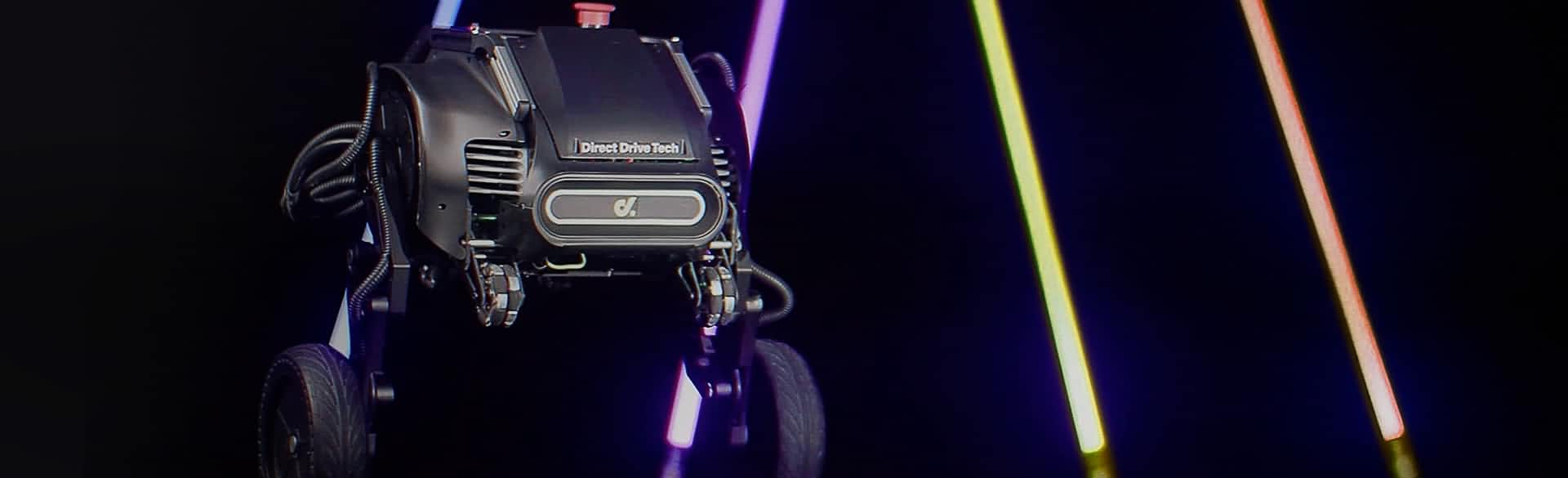
This requirement has increased interest in direct-drive systems. Unlike geared motors, direct-drive motors connect the motor directly to the wheel or mechanical output, reducing the number of moving parts. Products based on compact direct drive motors are designed for applications that require accurate control, low noise, and reduced maintenance. Some compact direct-drive solutions integrate the motor, encoder, and controller into one module, reducing installation complexity.
A direct-drive system can achieve very smooth movement because there is no gearbox backlash. This is useful for robots that perform precise indoor navigation, such as hospital delivery robots or household assistant robots. For example, a wheel module with high-resolution feedback can measure thousands of rotation points per revolution, improving odometry accuracy during long-distance movement.
One example of compact direct-drive technology is available through M06 series direct drive motors, which are designed for applications requiring compact size and precise motion control.
Motor selection also depends heavily on energy consumption. Mobile robots normally run on batteries, so every watt matters. A robot vacuum cleaner may use a battery between 30 Wh and 100 Wh, while larger service robots may use several hundred watt-hours. If drivetrain efficiency increases from 80% to 90%, the same battery can provide longer operating time or support additional sensors and computing hardware.
| Robot Application | Common Motor Type | Main Requirement |
|---|---|---|
| Robot Vacuum | Small BLDC motor | Low noise and high efficiency |
| Floor Cleaning Robot | BLDC with gearbox | Higher torque and long operating time |
| Delivery Robot | Servo motor or geared motor | Payload capacity and accurate control |
| Home Assistant Robot | Direct-drive or low-noise BLDC | Smooth movement and quiet operation |
| Hospital Robot | Integrated servo module | Reliability and precise positioning |
Noise performance is especially important for household robots. A motor running at high speed can create vibration and acoustic noise that affects user acceptance. Many residential robots are designed to operate below approximately 60 dB, requiring balanced rotors, low-friction bearings, and optimized motor control algorithms. Direct-drive motors can reduce mechanical noise because they remove gear teeth contact and gearbox vibration.
Thermal performance is another important design factor. Small robot housings provide limited space for heat dissipation. When motors operate continuously, heat accumulation can reduce efficiency and shorten component lifetime. Engineers often use aluminum housings, temperature sensors, and improved winding designs to maintain stable operation. Motors used in commercial robots are commonly tested under continuous operation periods exceeding 1,000 hours.
Control accuracy is closely related to motor feedback systems. Simple motors without position feedback may cause wheel speed differences between left and right sides, affecting navigation accuracy. Modern service robots commonly use Hall sensors, magnetic encoders, or optical encoders. Some advanced systems provide thousands of pulses per revolution, allowing the controller to make frequent speed adjustments.
The robot environment also determines protection requirements. Cleaning robots may encounter dust, moisture, and small particles, while outdoor delivery robots face temperature changes and uneven surfaces. Motors used in these applications may require higher protection ratings, sealed bearings, and improved mechanical structures. Commercial robots introduced after 2020 increasingly use integrated drive modules because they simplify maintenance and improve reliability.
The motor is not an isolated component. Its performance affects battery life, navigation accuracy, noise level, and the mechanical design of the entire robot platform.
Different robot designs require different motor characteristics. A vacuum cleaner focuses on efficiency and quiet operation, while a delivery robot needs stronger torque and better load handling. A household assistant robot may require a balance between smooth movement, compact size, and human-friendly operation.
The development trend after 2020 has moved toward smaller, smarter, and more integrated motor systems. Manufacturers are combining motors with sensors, controllers, and communication interfaces to create ready-to-install drive units. This approach reduces development time and allows robot companies to focus more on software, navigation, and user functions.
For future service robots, motor systems will likely include more internal sensing and adaptive control. Motors may automatically adjust output according to floor conditions, payload changes, or movement patterns. However, the basic selection factors remain consistent: sufficient torque, efficient operation, accurate control, low noise, and long service life. A well-matched motor allows cleaning, delivery, and home service robots to operate smoothly in real-world environments for extended periods.